
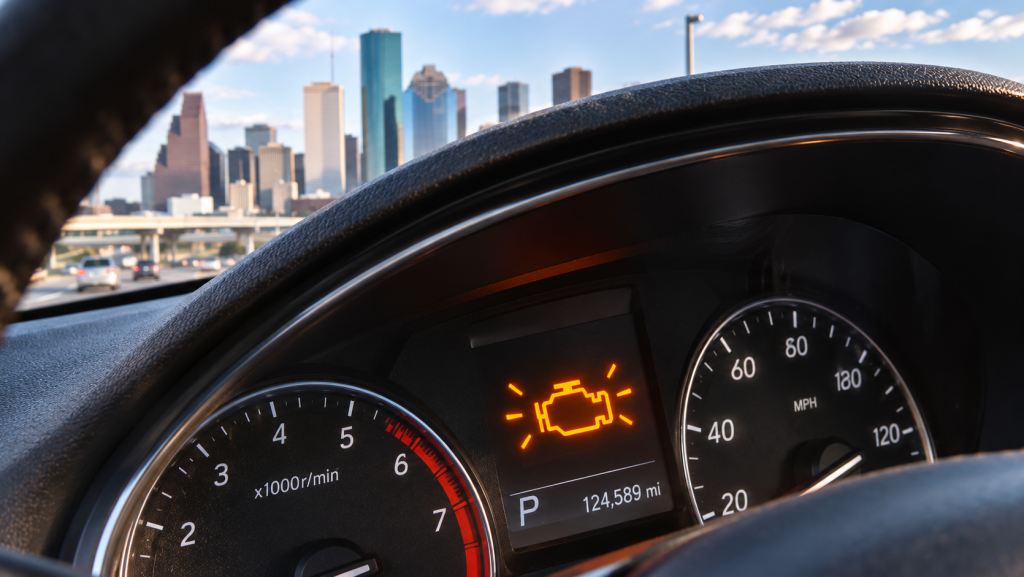
Most drivers have seen the check engine light glow steadily on the dashboard and decided it could wait. A flashing check engine light is a different story. When that light blinks, pulses or flickers while you drive, your car is telling you that something is wrong right now, and that continuing to drive could cause serious and costly damage. In a city like Houston, where heat, humidity, heavy traffic and long highway commutes are part of daily life, it is important to know the difference between a steady light and a flashing one, what usually causes it and what to do the moment it appears. This guide explains what a flashing check engine light means, why it is urgent, the most common causes, what to do and what a technician will check. If you are searching for help with a flashing check engine light in Houston, start here.
Steady Light vs Flashing Light
The check engine light, sometimes called the malfunction indicator lamp, is part of your car’s onboard diagnostic system. The engine computer monitors sensors and systems, and when it detects a problem outside normal limits, it stores a trouble code and turns on the light. The behavior of the light tells you how serious the computer thinks the problem is:
- A steady light means the system has detected a fault that should be checked soon. The car may be drivable, but it deserves attention.
- A flashing or blinking light usually signals a more severe condition, most often an active engine misfire that could harm other parts of the vehicle. Treat it as urgent.
Your owner’s manual explains how the warning lights behave in your specific car and what the manufacturer recommends when one comes on. If your manual says to stop driving when the light flashes, follow it.
Why a Flashing Light Is Urgent
The most common reason for a flashing check engine light is a misfire. A misfire means one or more cylinders are not burning the fuel and air mixture properly. When that happens, unburned fuel can travel into the exhaust system. The catalytic converter, which is designed to clean the exhaust, can overheat when it receives that fuel, and a damaged converter is a major repair. Misfires can also harm other parts of the engine, cause rough running and increase emissions. The longer you keep driving with a flashing light, the greater the risk.
Besides the risk of damage, a misfire can make the car run poorly in ways that affect safety, such as sudden loss of power when merging or climbing an on ramp. That is one more reason not to treat a flashing light as an inconvenience.
What You Might Notice Along With the Light
A flashing check engine light often comes with other symptoms:
- Shaking or vibration, especially at idle or under acceleration.
- Rough idle, with the engine sounding uneven or stumbling.
- Loss of power or hesitation when you press the accelerator.
- Jerking or surging.
- A smell of fuel or a rotten egg smell from the exhaust.
- Poor fuel economy.
- Backfiring or popping sounds.
- Stalling.
Not every flashing light brings obvious symptoms, though, so do not wait for the car to feel bad before acting.
Common Causes of a Flashing Check Engine Light
Worn or failing spark plugs
Spark plugs ignite the fuel mixture. When they are worn, fouled or damaged, they can fail to fire reliably, leading to a misfire. This is one of the most common causes.
Faulty ignition coils or wires
Ignition coils supply the high voltage the spark plugs need. A failing coil, or on older vehicles a bad spark plug wire, can cause a cylinder to misfire. Heat and age can wear these parts, and Houston’s humidity can make electrical problems worse. Our post on how Houston’s humidity impacts your car’s electrical system explains why moisture can lead to ignition and wiring trouble.
Fuel delivery problems
A clogged or failing fuel injector, a weak fuel pump or a problem with fuel pressure can cause the engine to run lean or rich in a cylinder, leading to misfires.
Vacuum leaks or air intake problems
A cracked hose, a leaking gasket or an issue with the intake system can let in unmetered air, upsetting the air and fuel balance and causing rough running and misfires.
Sensor problems
Sensors tell the engine computer how much air is coming in, how the engine is running and what the exhaust looks like. A failed sensor can cause bad readings and poor engine control. Many sensor issues trigger a steady light, but some can lead to misfires.
Mechanical engine problems
Less often, a misfire can come from internal engine trouble, such as low compression from a worn valve, a damaged piston ring, a bad head gasket or a timing issue. These are serious and need professional diagnosis.
Contaminated or poor quality fuel
Water or contaminants in the fuel can cause misfires and rough running, especially after flooding or filling up at a questionable source.
A failing catalytic converter
Sometimes the converter itself is the problem, and a clogged or damaged one can cause performance problems and lights on the dash. A converter can also be damaged by a misfire that went on too long.
What to Do When the Light Starts Flashing
If your check engine light begins to flash while you are driving, take these steps:
- Stay calm and ease off the accelerator. Reducing the load on the engine can lessen the misfire and the risk of damage.
- Find a safe place to pull over. Use your turn signal, check your mirrors and move off the road as safely as you can. Avoid stopping in a lane of traffic.
- Turn off the engine, if it is safe to do so.
- Check your owner’s manual for guidance on what your car’s warning light means.
- Avoid continuing to drive if you can. If the light is flashing and the car is running rough, the safest choice is usually to call for help instead of pushing on.
- If you must move the car, go slowly and only a short distance to a safe location, using as little power as possible.
- Do not ignore other warning lights. If the oil pressure or temperature warning lights are also on, stop right away.
- Call a technician or tow service. A diagnosis will show what is wrong and what needs to be done.
It can be tempting to restart the car and see if the light stays off. Sometimes the light stops flashing and becomes steady, which can make the problem seem to go away. It has not. The code is stored, and the issue is still there, so have the car checked.
What About a Loose Gas Cap?
A loose or faulty fuel cap is a well known cause of a steady check engine light, since it can trigger an evaporative emissions code. It is a good first thing to check when a steady light appears, but it is not a typical cause of a flashing light. If the light is flashing, do not assume the gas cap is the problem.
How a Technician Diagnoses It
A proper diagnosis goes beyond reading a code. A technician will usually:
- Connect a scan tool to the diagnostic port to read stored and pending codes, including misfire codes that point to specific cylinders.
- Look at live data, such as sensor readings and engine performance, to understand what is happening.
- Inspect spark plugs, ignition coils, wires and connectors.
- Check fuel delivery components and fuel pressure.
- Look for vacuum leaks and intake problems.
- Test engine compression if a mechanical issue is suspected.
- Inspect the exhaust system and catalytic converter for damage.
A code alone is only a starting point. The same misfire code can have several different causes, so testing helps confirm the real problem before parts are replaced. If you want to know how this works in practice, our post on car repair without leaving home explains how a technician can handle diagnostics and repairs at your location.
How the Problem Is Fixed
The repair depends on the cause. Common fixes include replacing spark plugs, ignition coils or wires, cleaning or replacing fuel injectors, repairing vacuum leaks, replacing faulty sensors or addressing fuel delivery problems. If the misfire has damaged the catalytic converter, that may need to be replaced too, which is another reason to stop driving quickly. Serious mechanical problems need a deeper repair, and a technician can explain the options. After repairs, the technician usually clears the codes and test drives the car to confirm the problem is solved.
How to Reduce the Chance of Misfires
- Follow your owner’s manual maintenance schedule, including spark plug replacement intervals.
- Do not ignore a steady check engine light. Early attention can prevent a flashing one later.
- Use good quality fuel from a reliable source, and avoid running the tank very low.
- Keep up with air filter and general engine service.
- Pay attention to rough idle, hesitation or poor fuel economy, since they are early hints.
- Be extra careful after heavy rain or flooding, since moisture can affect ignition and electrical parts.
How a Mobile Mechanic Can Help
A flashing check engine light is the kind of problem that makes you reluctant to drive across town. A mobile mechanic can come to your home, your workplace or the place where you stopped, scan the codes, run tests and find out what is causing the misfire. In many cases, common repairs such as spark plugs and ignition coils can be done on site, which may save you a tow. If the problem is more serious or needs specialized equipment, a good technician will tell you honestly whether a shop visit is needed.
Quick Summary
- A steady light means get it checked soon. A flashing light means act now.
- Flashing usually points to an engine misfire that can damage the catalytic converter.
- Ease off the accelerator, pull over safely and avoid driving farther than necessary.
- Common causes include spark plugs, ignition coils, fuel delivery and vacuum leaks.
- A proper diagnosis finds the real cause before parts are replaced.
- Regular maintenance reduces the chance of misfires.
If your check engine light is flashing, do not wait for the problem to get worse. To have a technician take a look, visit our homepage to learn more, or contact us to schedule a visit.